
Architecture Firm in Lebanon: How to Choose the Right Partner for a High-Value Project
A successful building begins long before construction starts.
It begins with decisions: how the property responds to its site, how people move through it, how natural light enters, how private and public spaces relate, how architecture connects with interiors and landscape, and how the original design intent survives the technical and construction process.
For this reason, choosing an architecture firm in Lebanon should not be treated as a search for someone who can simply prepare drawings.
For a villa, residential development, commercial project or other high-value property, the architect becomes a strategic partner whose decisions can influence experience, efficiency, identity and long-term value.
So what should a serious client evaluate before making that appointment?
Look Beyond a Beautiful Portfolio
A portfolio is naturally one of the first things clients examine.
But it should tell you more than whether you like a particular façade.
Look across several projects. Do they respond differently to different sites, clients and programs, or does every project appear to follow the same formula?
Strong architecture does not require every building to look alike. A villa, office, commercial development and hospitality project have different functional and experiential requirements.
What matters is consistency in the quality of the thinking.
- clear spatial organization;
- thoughtful proportions;
- intelligent use of natural light;
- strong connections between interior and exterior spaces;
- appropriate materials;
- attention to landscape and context;
- details that reinforce the architectural concept.
The best portfolio should make you interested in the decisions behind the images, not only the images themselves.
Prioritize Experience Relevant to Your Project
Experience is valuable when it relates to the project you are planning.
If you are developing a villa, study how the architects have approached privacy, views, circulation, outdoor living, landscape and family life.
For a commercial project, examine whether the practice understands customer flow, visibility, operations and brand experience.
For an office, consider planning, acoustics, meeting spaces, natural light, employee experience and future flexibility.
For a larger development, ask whether the team has experience coordinating complex programs and multiple consultants.
The goal is not necessarily to find architects who have completed a project identical to yours.
It is to find a team that understands the kind of decisions your project will require.
Start With the Site, Not the Façade
A high-value architectural project should not begin with an image of what the façade might look like.
It should begin with the site.
Orientation, topography, access, neighboring buildings, privacy, sunlight, views and surrounding landscape can all influence the architecture.
This is particularly important in Lebanon, where properties may vary dramatically in slope, exposure and context even within the same region.
Ask how the firm analyzes the site.
Why is the building positioned in a particular way? Why do important openings face certain directions? How does the arrival sequence work? How are views protected? How is privacy maintained? How does the building meet its landscape?
When these questions are resolved well, the building begins to feel as though it belongs to the site rather than having simply been placed on it.
Architecture and Interior Design Should Speak the Same Language
One of the common weaknesses in complex projects is fragmentation.
The architecture is developed first. Interior design follows. Lighting, furniture, landscape and engineering are introduced at different stages.
Each discipline may be good on its own, but the project can gradually lose coherence.
Architecture and interiors should influence each other early.
Window positions affect furniture layouts. Ceiling design interacts with lighting and mechanical systems. Exterior materials influence interior transitions. Landscape affects privacy and the experience of arrival. Floor levels influence the relationship between rooms, terraces and gardens.
For high-end residential and commercial projects, coordination between architecture and interior design is not simply convenient. It can significantly improve the consistency of the final environment.
Evaluate Technical Coordination
An impressive concept still has to become a buildable project.
Architecture interacts with structural engineering, mechanical systems, electrical systems, plumbing, lighting, façades, kitchens, landscape, automation, security and specialist suppliers.
The more complex the project, the more important coordination becomes.
Ask how the architectural team works with consultants.
How are conflicts identified? How are ceiling requirements coordinated? How are service routes incorporated without compromising important spaces? How are consultant drawings reviewed against the architectural design?
Technical coordination may not be the most glamorous part of architecture, but it often determines whether the completed project looks intentional or improvised.
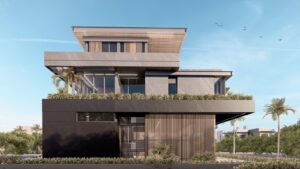
Use 3D Visualization as a Decision Tool
Plans and elevations are essential, but many clients understandably find it difficult to imagine the final space from technical drawings alone.
3D visualization can bridge that gap.
It can help clients and designers assess:
- building mass and proportions;
- material combinations;
- façade composition;
- interior atmosphere;
- furniture scale;
- natural and artificial lighting;
- landscape relationships;
- views through the project.
Visualization should not only be a polished image created when everything has already been decided.
Used during design development, it can reveal issues before they become expensive changes during construction.
Consider Construction Awareness
Architecture eventually becomes physical.
Materials need to be installed. Details have to be built. Custom elements need to be fabricated. Different trades need to work together.
A simple-looking junction on a render may involve complex construction coordination.
Even when the architect is not acting as the contractor, execution awareness matters.
Architects who understand construction can design details more realistically and communicate more effectively with contractors and suppliers.
If design and contracting services are both part of the appointment, responsibilities, approval procedures and construction-stage involvement should be clearly defined from the start.
Compare Scope Before Comparing Fees
Fees matter, but comparing architecture firms on price alone can be misleading.
Two proposals can carry the same heading while including very different levels of service.
Before comparing fees, understand whether the proposal includes:
- concept design;
- design development;
- detailed drawings;
- interior design;
- landscape design;
- 3D visualization;
- engineering coordination;
- material selection;
- tender assistance;
- shop-drawing review;
- site visits;
- construction-stage support.
A lower design fee may ultimately become expensive if important decisions have been excluded and must later be resolved under construction pressure.
The better question is not simply:
“How much does the architect cost?”
It is:
“What level of design thinking, documentation and coordination am I receiving?”
Communication Is Part of Project Quality
High-value projects involve hundreds of decisions.
Before appointing a practice, understand who will lead your project, how meetings will work, how design options will be presented and how decisions and changes will be recorded.
Good communication does not mean endless meetings. It means the client receives the right information at the right time.
A strong architect-client relationship gives the owner enough visibility to make informed decisions without forcing the client to personally manage the entire design process.
10 Questions to Ask Before Appointing an Architecture Firm
- What experience do you have with projects of similar scale and complexity?
- How do you begin analyzing a site?
- Who will lead our project?
- How are architecture, interior design and landscape coordinated?
- How do you work with structural, mechanical and electrical consultants?
- At what stages do you use 3D visualization?
- What drawings and deliverables are included in your scope?
- How are design changes managed?
- What involvement do you maintain during construction?
- How do you protect the design intent as the project moves toward execution?
The answers can tell you far more than a fee comparison alone.
Choosing an Architecture Firm in Lebanon Is Ultimately About Fit
The right architecture firm is not necessarily the largest practice or the studio with the most dramatic rendering.
It is the team whose design approach, technical capability, relevant experience and communication style match the ambition and complexity of your project.
For a high-value development, the architect should connect site, architecture, interiors, landscape, engineering and execution into one coherent direction.
Planning a villa, residence, commercial development or other significant project? Speak with WELD about your site, objectives and design ambitions.